

Helical gear motors see regular use in continuous industrial equipment. They combine speed reduction, torque output, and smoother gear engagement. These features come together in one drive package. Selection should rely on actual load. It must consider output speed. Starting torque is important. Duty cycle matters. Radial load needs attention. Installation layout and maintenance access are critical too. Do not choose based on motor power by itself.

Why Are Helical Gear Motors Suitable for Continuous Industrial Equipment?
How Does Helical Gear Transmission Improve Continuous Operation?
Helical gear transmission uses angled teeth. These teeth enter mesh gradually. They avoid sudden full-width tooth impact. Contact develops slowly across the gear face instead. This approach supports smoother power transmission. It can reduce vibration sent into shafts, bearings, couplings, housings, and the machine frame.
In equipment that runs for long periods, smoother meshing helps keep solid tooth contact. It supports bearing performance. It also helps maintain drivetrain alignment. Increased noise, vibration, or temperature can signal lubrication film breakdown. They may indicate bearing wear. Mounting instability or changing load conditions could be the cause as well.
Transmission efficiency is another important factor. Continuous duty can turn small losses into heat. These losses also raise operating costs. Real efficiency comes from gear design, ratio, load point, speed, lubrication, seals, bearings, and assembly quality. A helical gear motor needs evaluation at the actual duty point. Avoid relying only on a general efficiency statement.
What Performance Factors Matter in Long-Running Industrial Machinery?
Continuous industrial machinery needs stable operation over many hours. Check output speed, operating torque, temperature, shaft loading, and inspection access.
Operating stability, energy efficiency, torque consistency, service life, and maintenance frequency are linked. Poor alignment can raise vibration and bearing load. Inadequate lubrication can increase temperature and noise. A drive sized only for average power may still fail during starts or load surges.
What Industrial Equipment Uses Helical Gear Motors?
Helical Gear Motors for Conveyor and Material Handling Systems
Belt conveyors, screw conveyors, bucket conveyors, and transfer equipment often use helical gear motors. They need stable output speed and continuous torque. The load calculation should include conveyed mass, friction, incline force, belt or screw resistance, startup resistance, and possible material accumulation after a stop.
Shaft loading is just as important as torque. A pulley, sprocket, or belt applies radial load to the output shaft. This load must be checked at the actual force point. A drive may meet torque and motor power requirements but still overload bearings if shaft extension, belt pull, or support distance is wrong.
Helical Gear Motors for Mixing and Processing Equipment
Industrial mixers, agitators, and processing machines usually have variable resistance. Load can rise as viscosity changes. It can increase when material is added. It may grow when a tool enters a denser part of the process. The drive may need enough starting torque to break away a loaded vessel. It also needs enough operating torque to continue without repeated overload.
The duty cycle should include loaded starts, running time, idle time, reversals, acceleration, and temporary peak torque. Mechanical and thermal capacity must be checked against the full pattern.
Helical Gear Motors for Automated Production Systems
Automated manufacturing equipment, assembly systems, and production-line drives emphasize compact installation. They require synchronized operation. Repeatable speed control matters. Drivetrain integration is also essential. The drive must often coordinate with upstream and downstream equipment. It must keep acceleration predictable at the same time.
With variable-speed control, treat the motor, controller, gear motor, coupling, and driven machine as one system. Reflected inertia, acceleration torque, deceleration demand, and speed changes influence response time. A universal acceleration ramp rarely fits every machine.
How Should a Helical Gear Motor Be Selected for Continuous-Duty Applications?
Determine Required Torque, Speed, and Power Based on Equipment Load
Start with the process. Define the required output speed from conveyor velocity, mixer speed, or production-line timing. Then calculate operating torque at the output shaft. Identify starting torque, acceleration torque, and short peak loads as well.
The industrial gear reducer category frame selection is based on output speed, operating torque, motor power, reduction ratio, and shaft loading. Example: if output speed is 60 r/min and operating torque is 250 N.m, output power is about 1.57 kW. With an illustrative transmission efficiency of 0.90, input power is about 1.74 kW. The final choice still needs starting torque, service factor, radial load, temperature, and mounting checks.

Consider Duty Cycle and Peak Loads During Operation
Classify the application as continuous duty or intermittent duty. Then record running hours, starts and stops, reversals, acceleration time, load inertia, ambient temperature, and temporary overload. These conditions determine the required margin.
Safety factors should reflect driven-machine severity and reliability targets. They should not be used as a fixed shortcut. A machine with frequent loaded starts can require a different selection from a similar machine that runs steadily after startup.
Select the Right Installation Arrangement for Equipment Integration
Mounting method, shaft configuration, installation space, and machine layout affect transmission performance and maintenance. Foot mounting may simplify foundation support. Flange mounting may suit compact frames.
Check coupling alignment, shaft extension, bearing distance, belt or sprocket position, and service clearance. Poor installation can reduce bearing life even when torque and motor power look correct.
What Design Features Improve Helical Gear Motor Reliability?
Improve Efficiency Through Precision Helical Gear Manufacturing
Reliability depends on gear accuracy, tooth contact, lubrication, bearing support, housing rigidity, and assembly consistency. Smooth helical meshing helps only when the drivetrain maintains alignment under load.
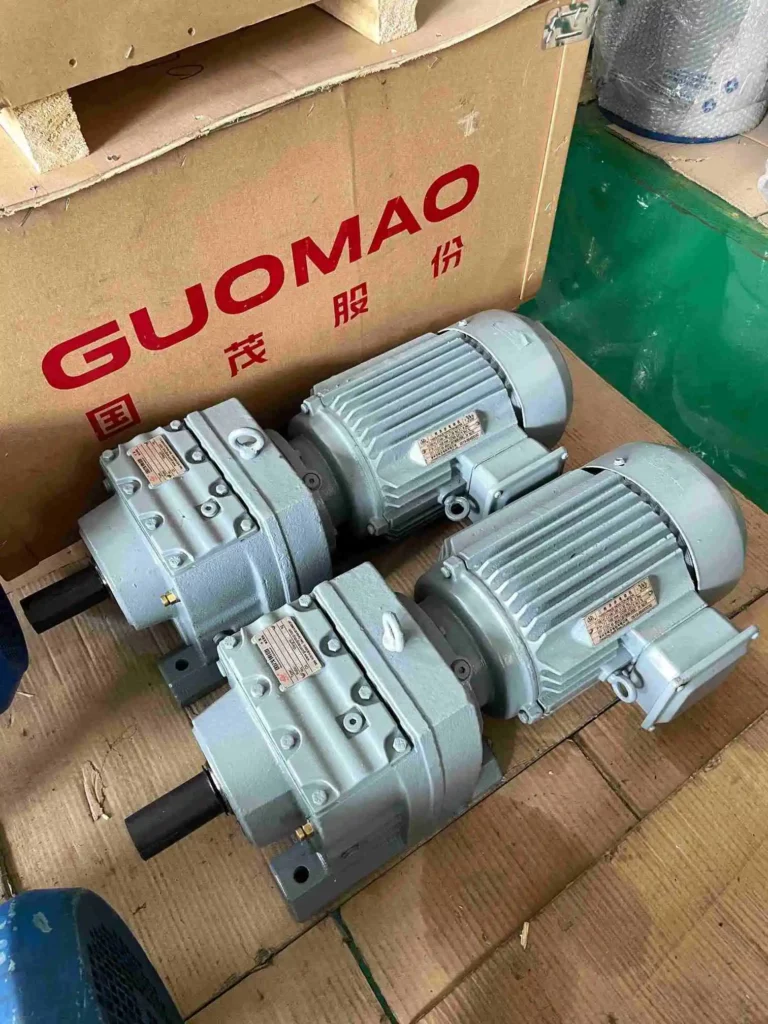
For continuous industrial applications requiring stable transmission performance, Guomao’s GR Series Helical Geared Motor applies helical gear transmission with high precision. It offers low noise operation, high transmission efficiency, long service life, easy maintenance, and radial-load capability. GR units use single-stage, two-stage, or three-stage helical gears for compact integrated drive systems. We match the final specification to the actual load case. See the GR Series Helical Geared Motor for product-level selection context.
Adapt Different Industrial Machines Through Flexible Configurations
Different machines need different installation arrangements. The GR Series Helical Geared Motor supports foot-mounted and B5 flange-mounted configurations. It allows multiple input shaft arrangements. It also offers an optional extended bearing housing.
Match these options to the machine frame, coupling position, maintenance clearance, and load direction. Flexible configuration is valuable when it improves alignment, access, or support.
Match Output Performance With Different Equipment Requirements
The GR Series Helical Geared Motor covers 0.12-200 kW, ratio 1.26-33000, and maximum output torque up to 50 kN.m. These figures describe the available range. The selected specification must still match output speed, operating torque, starting torque, reduction ratio, transmission efficiency, radial load, duty cycle, and installation layout.
How Can Helical Gear Motors Support Reliable Continuous Production?
Reduce Downtime Through Proper Drive Selection
Downtime is often reduced before operation begins. Define the load. Calculate speed and torque. Check starting and peak conditions. Verify shaft loading. Confirm mounting. Match the motor and control system. For related context, compare the drive requirements with this continuous-duty equipment guide.
This approach also prevents unnecessary oversizing. A larger drive may add cost and inertia. It does not solve poor alignment, unsuitable duty-cycle assumptions, or unsupported radial load.
Maintain Performance Through Regular Inspection and Maintenance
Maintenance should focus on abnormal noise, vibration, temperature rise, oil level, lubricant condition, seal leakage, coupling condition, foundation stability, and shaft alignment. A change in one symptom can have several causes. Inspect the full drivetrain.
Lubrication method and lubricant selection depend on reducer model, installation, and ambient conditions. Keep access available for inspection points. Set maintenance frequency according to operating hours, load severity, starts and stops, and stoppage risk.
FAQ
Q: What are helical gear motors used for in industrial equipment?
They are used for conveyors, material handling systems, mixers, processing machines, automated manufacturing equipment, assembly systems, and production-line drives that need reduced speed, stable torque, and long running cycles.
Q: Why are helical gear motors suitable for continuous-duty applications?
Their angled teeth engage progressively. This supports smoother power transmission and lower vibration. Continuous-duty suitability still depends on correct torque, speed, thermal capacity, lubrication, alignment, shaft loading, and maintenance.
Q: How do I select a helical gear motor for industrial machinery?
Define output speed, operating torque, starting torque, motor power, reduction ratio, transmission efficiency, duty cycle, peak loads, radial load, mounting method, shaft configuration, and environmental conditions.
Q: Are helical gear motors efficient for continuous operation?
They can be efficient. Actual efficiency depends on the selected ratio, load point, speed, lubrication, bearings, seals, and assembly. Evaluate efficiency under the real operating conditions.
Q: What factors affect the service life of a helical gear motor?
Service life is affected by torque margin, starts and stops, overload, temperature, lubrication, contamination, alignment, radial load, coupling condition, foundation rigidity, and maintenance quality.