


The choice between a helical and planetary gearbox becomes clearer when the machine’s real workload is written down. Steady conveying, frequent starts, shock loading, servo positioning, and restricted installation space each favor a different balance of torque capacity, size, efficiency, and serviceability. Start with the operating point and let the drive architecture follow from it.
Start With the Load, Not the Gearbox Label
Torque, speed, and duty cycle
Work out output torque from the driven machine, then add the effects of acceleration, reversing, starts per hour, and daily running time. Nominal torque can be misleading: a fully loaded conveyor start, a suspended hoist load, or a rapid cycle may impose a much higher demand. The service factor needs to describe that duty, not simply reproduce a catalog default.
The reducer also has to reach the target output speed at a workable motor speed. Check ratio, motor power, thermal conditions, and the radial or axial force introduced by a pulley, sprocket, or coupling. That simple check keeps the ratio from becoming the only selection criterion while shaft loading is overlooked.
Space, mounting, and radial load
The mechanical layout may settle the question before efficiency enters the discussion. Check shaft direction, foot or flange mounting, available width, and access for inspection and motor removal. A narrow machine may reward a compact planetary arrangement; a conveyor or mixer may be easier to integrate with a flexible helical geared motor.
Where a Helical Gearbox Fits Best
Continuous industrial motion
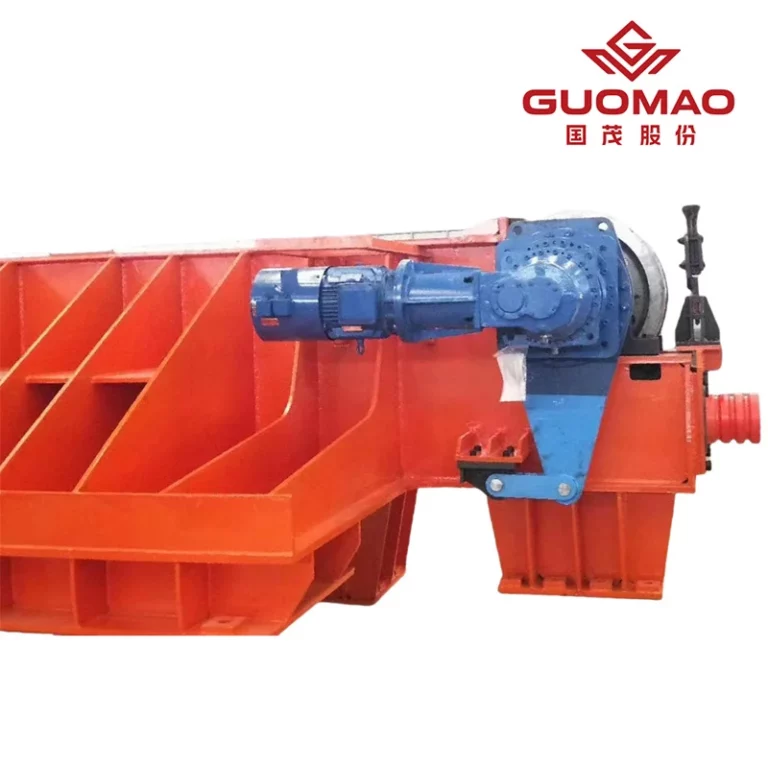
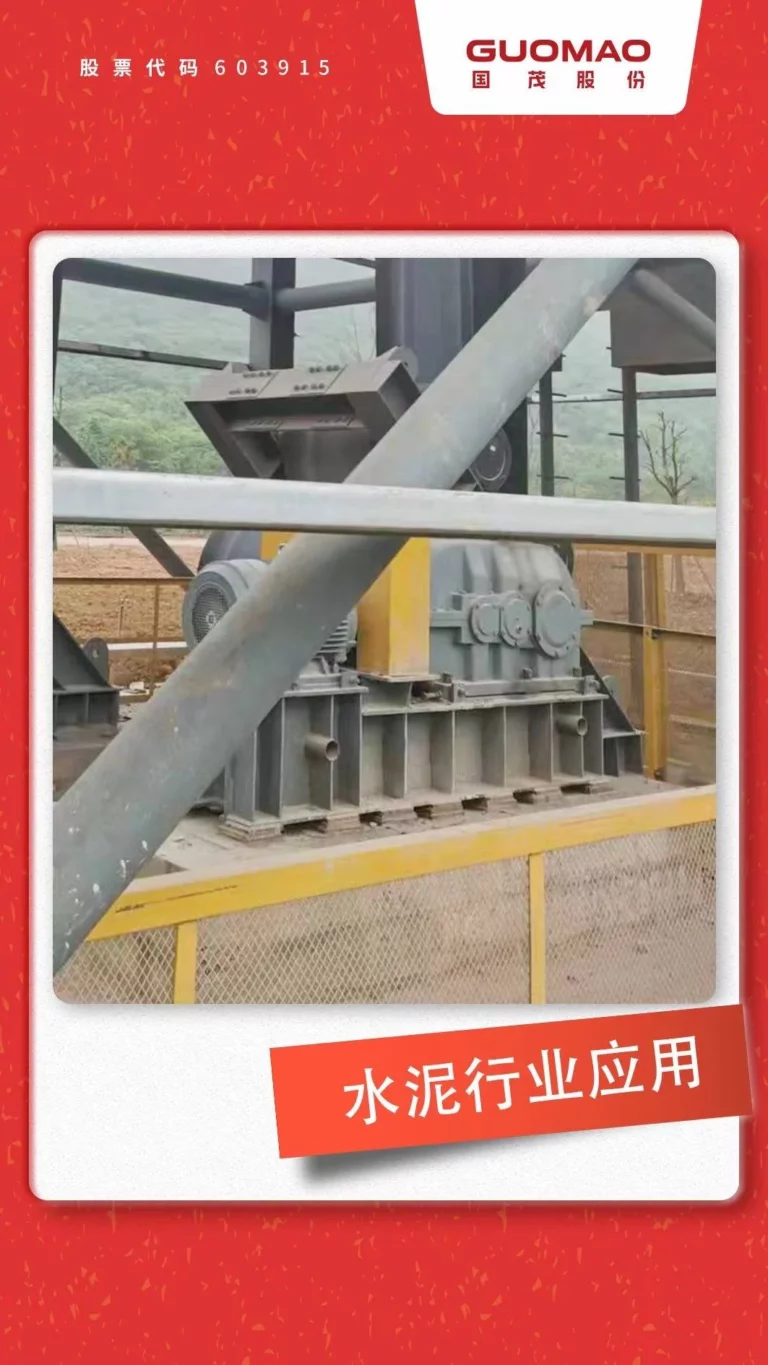
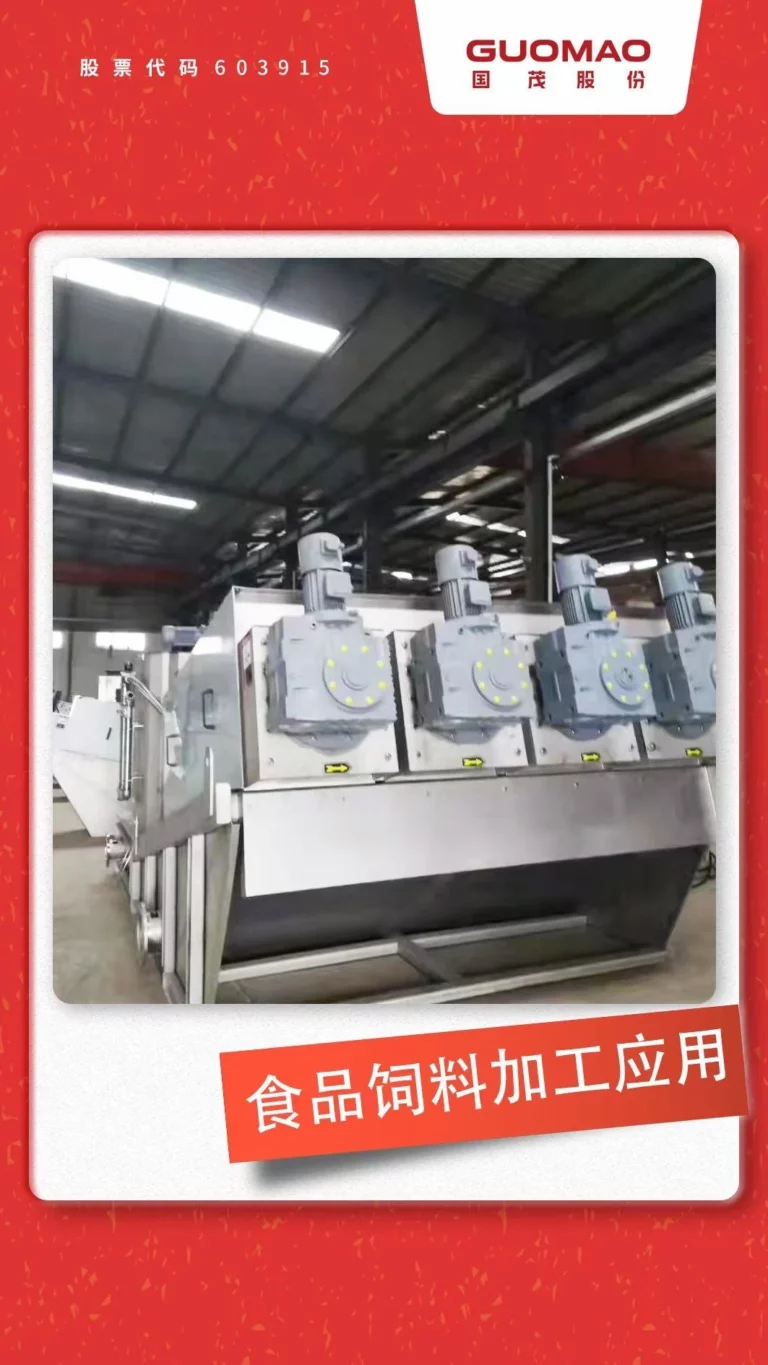
Helical gearing is often a strong fit for continuous-duty drives that need efficient, quiet, and maintainable speed reduction. The inclined teeth engage progressively, which supports smooth torque transmission and controlled noise when the gears, bearings, lubrication, and housing are correctly selected. Typical examples include conveyors, winches, charging equipment, homogenizing equipment, and other plant machinery with predictable operating cycles.
When the GR Series is a practical match
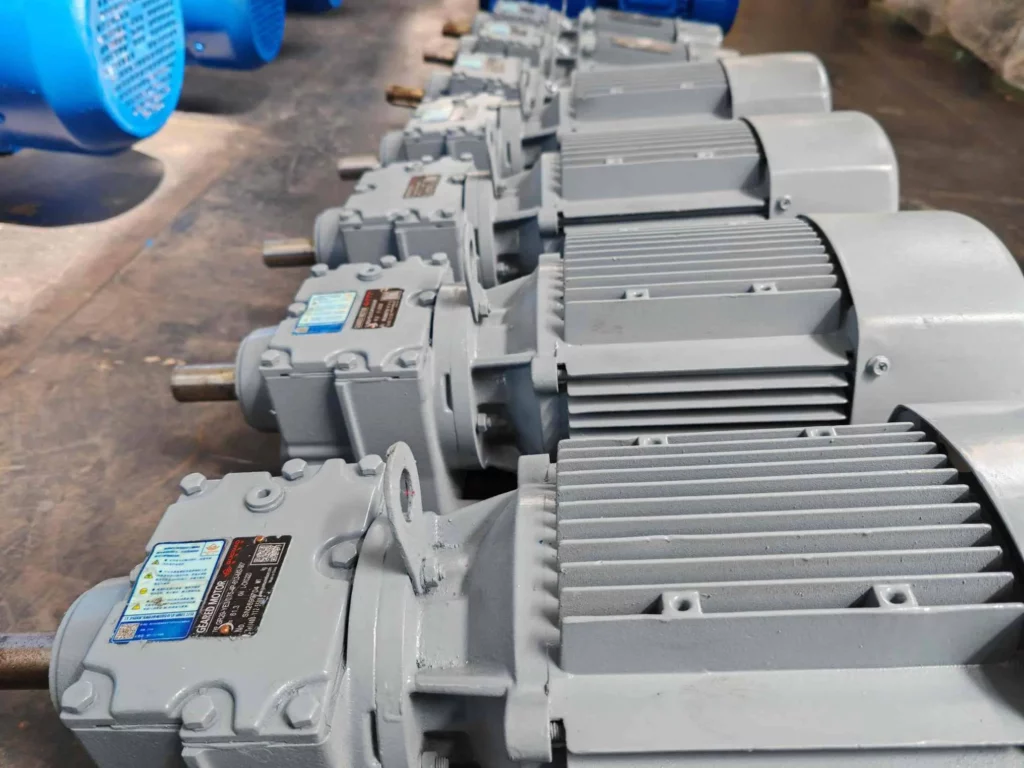
The GR Series Helical Geared Motor uses single-stage, two-stage, or three-stage helical gears and is available with foot-mounted or B5 flange-mounted installations. Its product range is described with power from 0.12 to 200 kW, ratios from 1.26 to 33000, and maximum output torque up to 50 kN.m. That makes the GR Series Helical Geared Motor a sensible starting point when the drive needs modular installation, a broad ratio range, and reliable continuous transmission.
We can match the drive architecture to the load spectrum, speed, mounting, and service expectations before a final size is chosen.
Guomao provides the GR Series Helical Geared Motor for industrial drives that need modular installation, broad ratio selection, and dependable continuous transmission.
The GR design is especially practical when the motor and reducer need to form a straightforward integrated unit. It can support multiple input arrangements and an extended bearing housing, so the selection should still verify the actual overhung load, duty factor, and mounting orientation rather than treating the series name as a complete specification.
Where a Planetary Gearbox Has the Advantage
High torque in a compact package
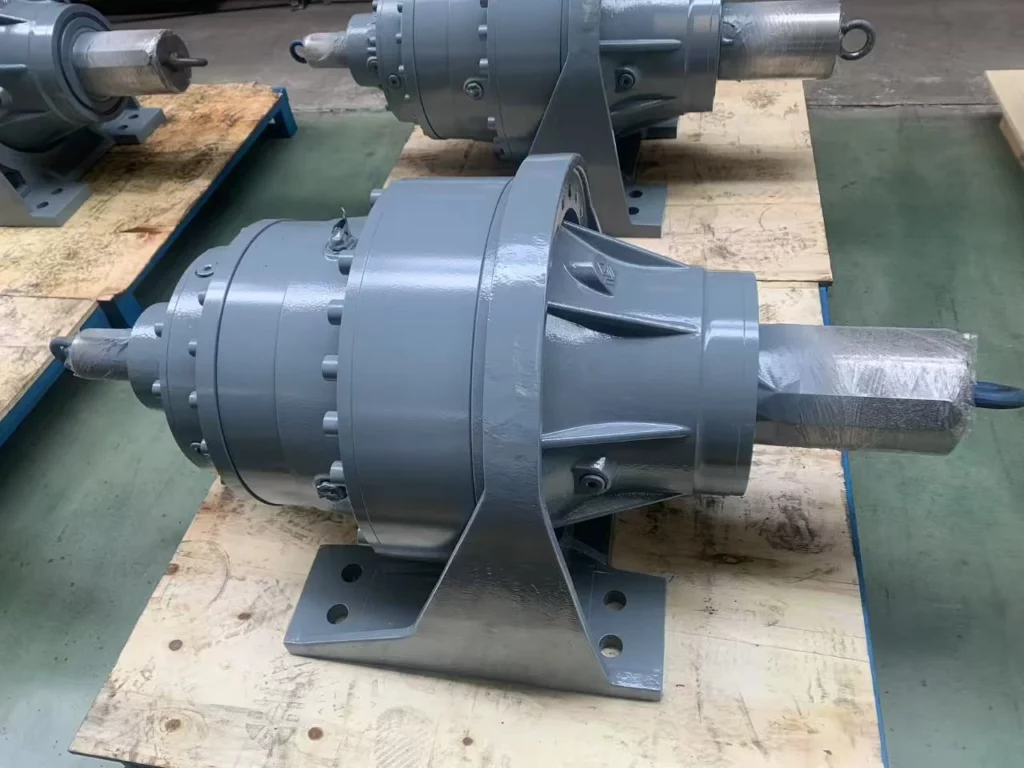
Planetary gearing distributes load through multiple satellite gears around a central sun gear. That architecture can provide high torque density and a compact envelope, which is valuable when a machine needs substantial output torque without a large reducer footprint. It can also suit high-speed input conditions when the bearings, lubrication, thermal design, and allowable loads are properly matched.
When the Engineering Mechanical Planetary Gearbox is appropriate
The Engineering Mechanical Planetary Gearbox is specified with a compact planetary design, large torque capacity, and an ability to adapt to high-speed drives. The documented range includes power from 0.37 to 540 kW and speed ratios from 3.4 to 2500. Its application examples include crushers, road rollers, pavers, milling machines, tower cranes, rotary drilling rigs, and marine or engineering ship equipment. Designers can review the Engineering Mechanical Planetary Gearbox when high torque density and severe industrial loading matter more than the simplest drive arrangement.
Planetary does not automatically mean more precise. For robotics and positioning axes, the relevant product is a precision planetary reducer, with backlash, torsional stiffness, servo inertia, and repeatability evaluated separately. For heavy industrial motion, the decision should remain tied to the load spectrum and not to the word “planetary” alone.
A Practical Comparison for Drive Designers
Efficiency, service life, and maintenance
Compare the efficiency of the whole drive, including the motor, bearings, seals, lubricant, cooling, and alignment. Helical arrangements are often familiar to maintenance teams and straightforward to inspect. Planetary arrangements can offer excellent torque density, but bearing support, lubrication, and assembly accuracy deserve closer attention as the load increases.
Maintenance planning should include oil inspection, seal condition, bearing condition, temperature, vibration, and mounting fasteners. Do not clean a reducer or motor by directly spraying it with water. Protect the drive from sunlight, weather, contamination, and unplanned washdown exposure according to the actual enclosure and installation conditions.
How to make the final choice
For continuous transmission, practical mounting, a wide ratio choice, and familiar maintenance, a helical unit is often the sensible starting point. A planetary unit earns its place when torque density, compact dimensions, high input speed, or multiple load-sharing paths matter more. In either case, close the selection by checking torque, ratio, speed, duty, shaft loads, thermal capacity, lubrication, mounting, and service access for the chosen size.
Once the application data is ready, the industrial gearbox range can help organize torque classes and layouts. Clear input data usually narrows the shortlist faster than comparing gearbox types in isolation.
FAQ
Q: What is the main difference between a helical vs. planetary gearbox?
A: A helical gearbox uses helical gear pairs that engage gradually. A planetary gearbox spreads the load among several satellite gears. These gears circle a sun gear. Therefore, the actual difference often comes down to the service layout. It also relates to the torque density.
Q: Is a planetary gearbox always more efficient than a helical gearbox?
A: No. Efficiency depends on many elements. These elements include the stages. They include the ratio. Bearings, lubrication, seals, speed, alignment, and load also play a part. One must compare the full drive. This should be done at its true operating point.
Q: When should an industrial drive use a helical gearbox?
A: Choose a helical design when the drive requires steady industrial transmission. It should also have broad mounting options. Smooth operation is important. The system must offer maintainable continuous-duty performance.
Q: When is a planetary gearbox the better choice?
A: A planetary gearbox is often the better choice. This occurs when torque density is critical. Compact dimensions may be needed. High input speed can be a key factor. The same is true for demanding shock loads. These aspects are central to the machine design.
Q: What information is needed to select either gearbox?
A: You need to provide the motor power. Include the input and output speed. The output torque is important. So are the duty cycle and starts per hour. The shock level should be given. Radial and axial loads are necessary details. The mounting position matters. Ambient conditions must be considered. Lubrication needs and the required service life are also essential.