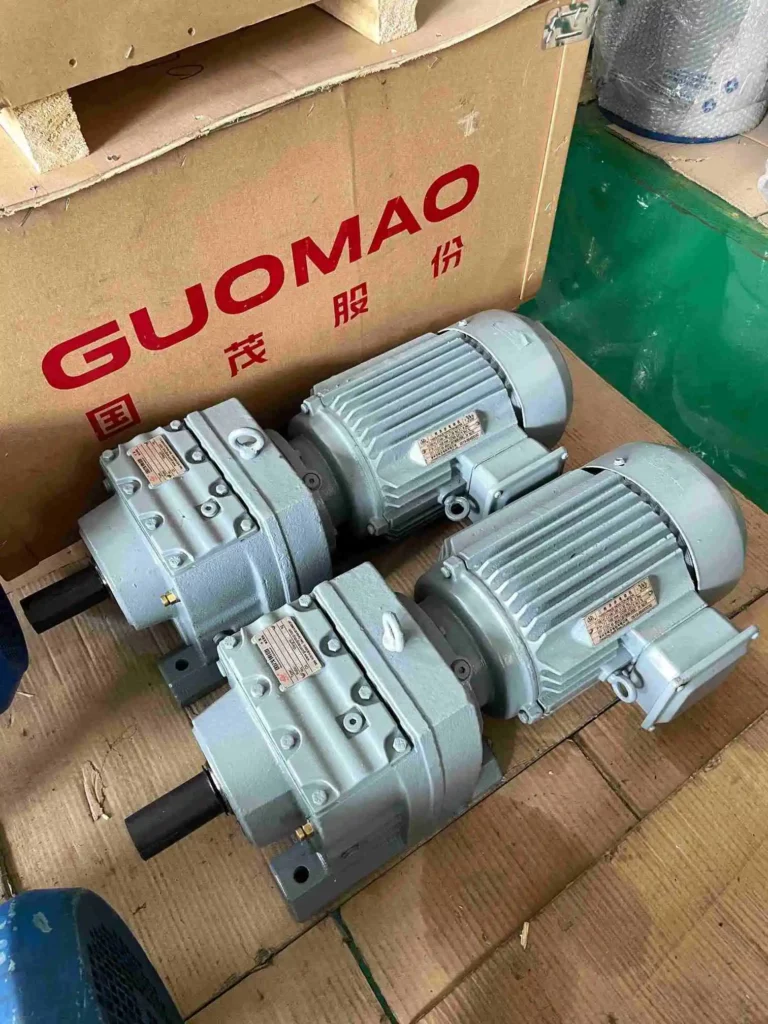


Gear motors for food industry processing lines should be selected from load, speed profile, sanitation zone, shaft loading, and production-line layout. Conveyors need continuous torque; mixers need starting torque; filling and packaging stations need repeatable speed and compact installation.
Where Are Gear Motors for Food Industry Processing Lines Used?
Gear Motors for Food Industry Conveyors and Material Transfer
Conveyors move raw materials to a process, transfer product between operations, and carry finished goods toward packing. Their drive must maintain continuous torque at the required output speed while carrying belt tension, product mass, incline force, and starting resistance. Radial load from a pulley, sprocket, or belt must be checked at the actual shaft-load point.
For a long-running conveyor, check output torque, acceleration torque, duty cycle, starts, stops, thermal conditions, and alignment. A parallel-shaft arrangement can help when frame space is limited. The GF Series Parallel-Shaft Helical Geared Motor provides foot-, flange-, and shaft-mounted options, with hollow or solid output shafts.

Gear Motors for Food Industry Mixing, Kneading, and Batch Processing
Mixers, dough mixers, agitators, and similar batch machines often have a variable load. Viscosity changes and material settling can raise operating torque. Starting torque may control selection when the vessel is loaded before the motor starts.
Size the drive from the worst part of the cycle. Separate operating torque from breakaway or acceleration torque, then account for intermittent duty, starts, reversals, and temporary overload. A service factor should reflect the machine, hours, load severity, inertia, ambient conditions, and reliability target.
Gear Motors for Filling, Packaging, and End-of-Line Production Equipment
Filling, bottling, labeling, sealing, and end-of-line packaging stations depend on speed consistency as well as torque. Output speed must match indexing, metering, and product transfer; variation can affect fill volume, spacing, sealing timing, or accumulation.
How Should Gear Motors for Food Industry Loads Be Sized?
Calculate Output Torque, Speed, and Gear Ratio From the Actual Process
Start with the driven element, not the motor nameplate. Define required output speed, operating torque, starting torque, motor power, gear ratio, and transmission efficiency. Output power is torque multiplied by angular speed, and a first ratio estimate is motor speed divided by required output speed.
For an illustrative conveyor, assume a pulley requires 180 N.m at 30 rpm and the motor runs at 1,500 rpm. The ratio is 50:1. Output power is about 565 W before losses; at assumed 90% efficiency, input mechanical power is about 628 W. These are assumptions, not GR or GF ratings.
Account for Duty Cycle, Start-Stop Frequency, and Peak Loads
Classify the process as continuous duty or intermittent duty. Record running hours, starts and stops, reversing events, acceleration time, peak torque, and idle intervals. Frequent starts increase acceleration torque and thermal cycling. A temporary overload requires checks of the gear motor, motor, control system, and coupling.
The working-condition coefficient should be derived from load characteristics, working time, and starts/stops. Temperature correction and an additional safety factor may also matter. The final service factor must meet actual demand.
Check Radial Loads and Output-Shaft Loading on Conveyor Drives
External components change the load case. Belt or chain tension creates radial load and sometimes an overturning moment. Use the actual force, direction, shaft extension, and bearing distance; do not assume the force acts at the shaft midpoint.
Verify coupling alignment, sprocket or pulley parallelism, shaft fit, and belt or chain tension. Torque capacity and motor power do not complete sizing when external transmission is attached to the shaft.
What Operating Conditions Matter for Gear Motors for Food Industry Production?
Separate Dry Processing Zones From Wet or Washdown Areas
Dry processing areas, humid processing zones, wet cleaning environments, and high-pressure washdown areas impose different requirements. Consider enclosure, sealing, mounting orientation, exposed materials, cable entry, drainage, cleaning distance, and sanitation chemicals.
An enclosure rating is not a universal answer by itself. Confirm the required rating for the complete installed assembly, including motor, connectors, glands, shaft seals, guards, and nearby controls. GR or GF product facts should not be expanded into claims of special stainless-steel construction, sanitation certification, or universal washdown suitability without explicit project evidence.
Evaluate Cleanability, Corrosion Exposure, Sealing, and Lubrication
Review moisture exposure, cleaning chemicals, corrosion risk, seal compatibility, lubricant leakage risk, and maintenance access. Where applicable, food-grade lubricant requirements must be confirmed with the machine builder and sanitation procedure. Lubrication method and oil selection depend on reducer model, installation, and ambient conditions; oil level must be monitored.
Inspect seals after cleaning. Leakage, noise, vibration, high temperature, or lubrication-pressure changes require checks of gears, bearings, couplings, seals, lubricant, cooling, and alignment.
Which Gear Motor Architecture Fits Different Food Production Line Layouts?
Inline Helical Gear Motors for Compact Processing Equipment
An inline or near-inline drivetrain keeps the motor and output path close to the machine axis, simplifying compact guarded equipment. Helical engagement supports smooth transmission, while the result depends on gear accuracy, bearing support, lubrication, mounting rigidity, and load stability.
The GR Series Helical Geared Motor is a compact option for integrated drive systems. GR units use single-stage, two-stage, or three-stage helical gears and support foot-mounted or B5 flange-mounted installations, multiple input arrangements, modular construction, and easy maintenance. Its stated range is 0.12–200 kW, ratio 1.26–33,000, and maximum output torque up to 50 kN.m. At Guomao, we match this option to real torque, speed, duty cycle, and environment.

Parallel-Shaft Helical Gear Motors for Conveyor-Line Integration
A parallel-shaft layout can package the drive closer to a conveyor frame and connect to a pulley or sprocket. Foot, B5/B14 flange, or shaft mounting and hollow or solid output shafts provide interface choices. Selection still depends on radial load, alignment, guarding, cleaning access, and bearing support.
The GF Series Parallel-Shaft Helical Geared Motor uses two or three helical-gear stages and has a stated range of 0.12–200 kW, ratio 1.26–33,000, and maximum output torque up to 50 kN.m. These are product-range facts, not a substitute for sizing. Use the industrial gear reducer category to compare architecture with the load case.
How Can Gear Motors Improve Reliability Across Continuous Food Production Lines?
Match Mounting and Shaft Configuration to the Machine Layout
Choose foot, flange, or shaft mounting according to the frame and load path. Confirm hollow versus solid output shaft, coupling, concentricity, shaft extension, support bearings, and clearance. Incorrect mounting can introduce shaft loading, shorten bearing life, and disturb alignment.
Coordinate Gear Ratio and Variable-Speed Control Across the Production Line
Coordinate upstream and downstream speed so conveyors, filling stations, packaging units, and accumulation sections do not fight each other. Use output speed and throughput to set the ratio, then confirm controlled acceleration and motor/VFD compatibility. An unnecessary ratio can complicate control and increase inertia.
Prevent Premature Gear Motor Failure Through Operating Condition Monitoring
Monitor abnormal temperature, vibration, unusual noise, oil or seal leakage, overload, misalignment, and repeated start-stop stress. Trend changes rather than waiting for failure, and connect symptoms to gears, bearings, seals, coupling, foundation, lubricant, cooling, and external belt or sprocket loading.
FAQ
Q: What are the best gear motors for food industry processing lines?
The best choice depends on the machine load, output speed, duty cycle, shaft loading, sanitation zone, and layout. GR suits compact inline or near-inline drives; GF suits selected parallel-shaft conveyor and production-line arrangements. Neither should be selected from product name alone.
Q: How do I size gear motors for food industry conveyor applications?
Calculate required output speed, operating torque, starting torque, ratio, motor power, efficiency, duty cycle, service factor, and radial load. Include pulley or sprocket force at its real shaft position, plus belt tension, acceleration, starts and stops, alignment, and ambient conditions.
Q: What IP rating should gear motors for food industry washdown areas have?
Start with the sanitation zone and cleaning method, then confirm the required rating for the complete installed assembly. An IP number alone does not confirm chemical compatibility, seal life, materials, lubricant suitability, or food-contact compliance. Do not assume GR or GF has an unverified washdown certification.
Q: Are helical gear motors for food industry production lines energy efficient?
Helical gearing can support smooth transmission and high transmission efficiency, but actual energy use depends on speed, torque, ratio, load, lubrication, temperature, alignment, motor control, and duty cycle. Evaluate the complete operating point rather than assuming one universal efficiency value.
Q: How should gear motors for food industry continuous-duty lines be maintained?
Monitor temperature, vibration, noise, leakage, oil level, lubricant condition, alignment, coupling condition, foundation stability, and radial loading. Inspect more closely after repeated starts, overloads, or cleaning exposure, and use the product-specific maintenance and lubrication requirements for the selected GR or GF unit.