


In continuous material handling, the conveyor belt gearbox converts motor power into stable pulley torque while absorbing start-up loads, belt resistance, and material surges. Reliability depends on the operating profile—not motor power alone. Sizing, lubrication, installation, and monitoring must keep torque, speed, and temperature stable.
Why Is Conveyor Belt Gearbox Reliability Critical in Continuous Material Handling?
How Continuous Duty Creates Mechanical and Thermal Stress
24 hours a day, 7 days a week – 16 hours or 24 hours a day of continuous loading of the gears, bearings, seals, and oil in a material handling gearbox. The gearbox must come to temperature and continue to function with lubricant film strength intact.
Torque and thermal capacity should be considered separately. One may find that a unit is rated for a certain torque but runs the risk of overheating due to a lack of airflow, wrong oil, or cooling.
How Starting Torque, Material Surges, and Belt Resistance Accelerate Wear
A loaded conveyor belt needs to overcome the inertia of the belt, the resistance of pulleys, idler friction, and the settled material on the belt. Additional transient loads are introduced by uneven feeding, blocked transfer points, and emergency start-ups.
Reliable conveyor gearbox reliability calculations must consider the credible starting torque and shock torque as well as average power.
How Gearbox Instability Affects Belt Speed and Material Flow
Bearing clearance, tooth wear, or unstable lubrication can cause torque fluctuations, speed variation, vibration, tracking problems, spillage, or inconsistent discharge. Motor current and belt tension may also become unstable.
What Operating Data Is Needed Before Selecting a Conveyor Belt Gearbox?
Define Belt Pull, Pulley Diameter, Belt Speed, and Required Output Torque
Selection should begin at the drive pulley using belt pull, pulley diameter, speed, and maximum torque. A conveyor gearbox torque calculation converts belt pull into pulley torque while accounting for acceleration and losses.
Evaluate Daily Operating Hours, Start-Stop Frequency, and Load Variation
The gearbox service factor for belt conveyors is influenced by the following key parameters: Operating hours, starts per hour, load variation, and plugging events. All of these factors affect the design criteria of gear capacity, bearing life, shaft loading, and thermal margin.
Account for Dust, Moisture, Ambient Temperature, and Installation Conditions
Dust, water, humidity, and temperature have an effect on the sealing system, breathers, lubricant, and maintenance schedule. Orientation in which a bearing is mounted has a large influence on oil flow and should be specified for lubricant selection.
How Should a Conveyor Belt Gearbox Be Sized for Continuous Duty?
Calculate Conveyor Drive Torque Under Running and Starting Conditions
Design torque should include steady demand and the highest realistic transient load. Inclined, loaded, or long conveyors need particular attention.
For a heavy-duty conveyor belt gearbox, a variable-frequency drive or soft-start system can reduce acceleration peaks.
Select the Gear Ratio from Motor Speed and Required Belt Speed
Calculate the ratio from the motor and pulley speeds. An incorrect ratio alters belt velocity, throughput, and transfer behavior, while the selected ratio must remain within speed, torque, and thermal limits.
Apply Service Factors for Continuous Operation and Shock Loading
A continuous-duty gearbox service factor should reflect running hours, starts, load severity, and environment. Higher design margin lowers normal capacity utilization and improves tolerance to transients.
Verify Radial Load, Overhung Load, and Output-Shaft Bearing Capacity
Pulleys and couplings can impose substantial radial force. An overhung load calculation for a conveyor gearbox should include torque, pitch radius, belt tension, and load-point distance.
Adequate torque capacity does not guarantee adequate shaft or bearing capacity.
Check Thermal Capacity, Lubrication Demand, and Cooling Requirements
| Design variable | Reliability consequence |
| Insufficient oil flow | Gear and bearing distress |
| Excessive oil level | Churning losses |
| Low oil viscosity | Reduced film thickness |
| Restricted airflow | Poor heat dissipation |
| Incorrect mounting | Inadequate lubrication |
| Undersized cooling | Progressive overheating |
Which Gear Technologies Support Reliable Conveyor Operation?
Heavy-Duty Industrial Gearboxes for High-Torque Conveyor Drives
In heavy bulk handling applications, high gear ratios, robust gear housings, suitable bearings, and adequate lubrication provision are more important than the shaft configuration.
Gear Accuracy, Tooth Contact, and Load-Carrying Capacity
Precision-ground gears create better contact surfaces and more balanced loads. In continuous operations, Grade 6 accuracy and proper profile modification minimize meshing disturbances.
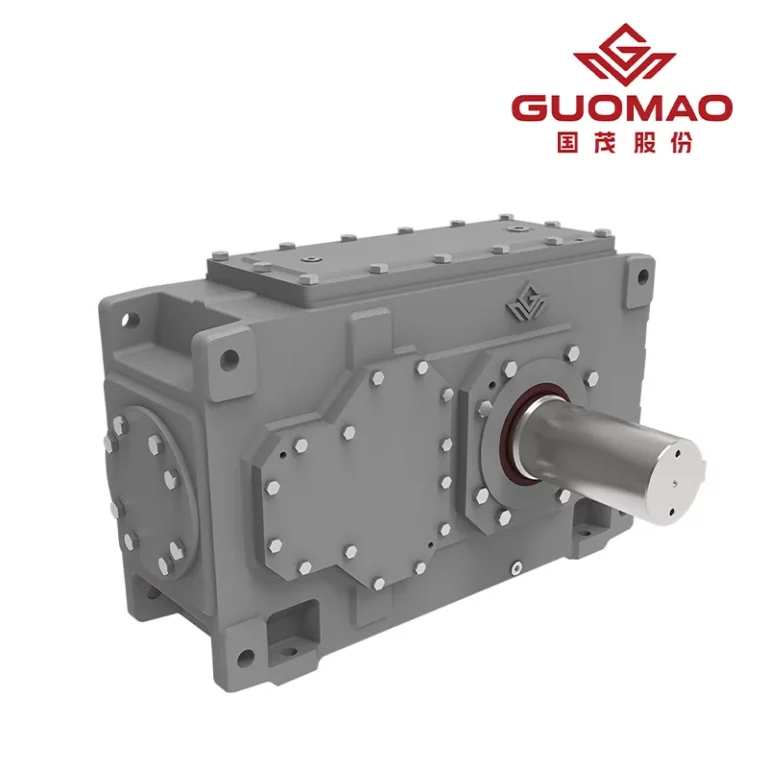
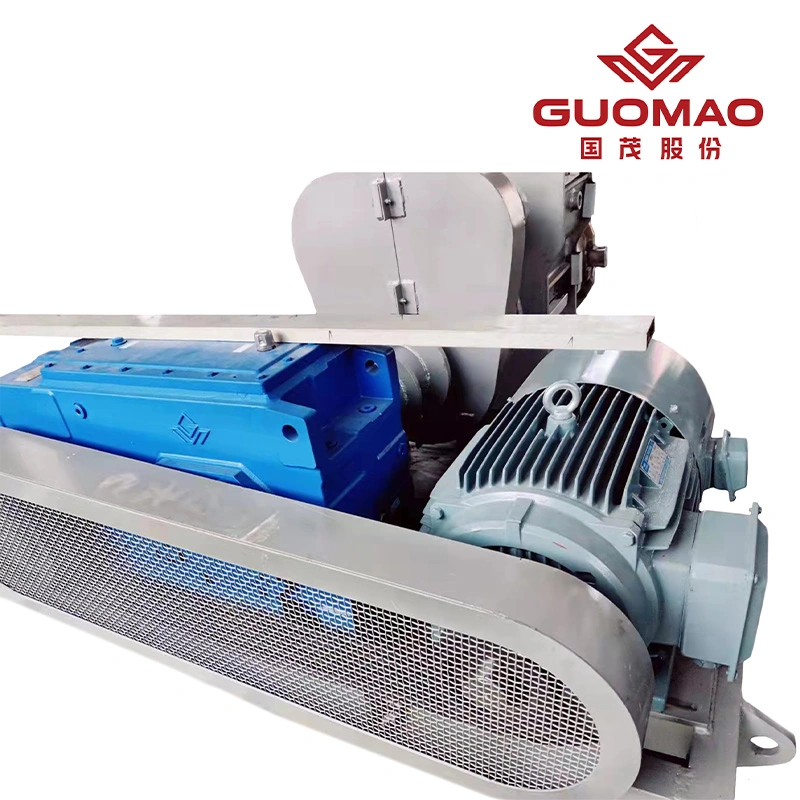
The Guomao HB Series Industrial Gearbox for this application uses helical and bevel gear calculations following GB/T, DIN, and ISO methods. The design has been fully loaded for fatigue on all aspects of the design, including gearing, materials, bearings, manufacture, and assembly, allowing the gearbox to be used in a high-torque industrial conveyor application.
Lubrication, Cooling, Sealing, and Bearing Configuration
Some industrial gearboxes require fans, external oil circulation, air coolers, special seals, or even other types of bearings to achieve the required operating conditions.
Our HB Series bearings are offered in a variety of mounting configurations. The documented bearing-life targets for the HB Series are increased as the service factor is increased.
Hard-Tooth-Surface Cylindrical Gear Reducers for Continuous Transmission
Carburized and Quenched Gears for Wear Resistance
By carburizing and quenching high-strength low-carbon steel alloys, it is possible to produce wear-resistant surfaces and core areas that are particularly tough.
Guomao ZY Series Cylindrical Gear Reducer is made by a hard tooth surface process, with a hardness of the tooth surface up to HRC58–62; it can be used as a hard-tooth-surface conveyor gear reducer under material surge and continuous working conditions.
Precision-Ground Gear Teeth for Stable, Low-Noise Operation
The Precision grinding ensures perfect contact and ideal load transfer. Our ZY Series is available from a single stage to 4 stages, depending on the application.
Efficiencies stated for single-stage sprockets of about 98%, two-stage 96%, and three or more stages over 95% – all help to keep losses down, which is important for maintaining thermal stability of a continuous conveyor drive system.
How Should a Conveyor Belt Gearbox Be Installed and Commissioned?
Align the Motor, Coupling, Gearbox, and Conveyor Drive Pulley
Misalignment creates coupling forces, bearing loads, vibration, and uneven gear contact. Use a flat, rigid foundation and recheck alignment after fastening.
Confirm the Mounting Position, Oil Level, Breather, and Sealing Arrangement
Verify orientation, oil level, lubricant viscosity, breather, seals, and cooling prior to start-up. An incorrect oil level can cause oil starvation or churning.
Use Progressive Loading to Establish Temperature, Noise, and Vibration Baselines
Start without load and gradually increase load in stages. Record temperature, vibration, noise, oil pressure, and motor current to create a basis for condition monitoring of the conveyor gearbox.
What Causes Conveyor Belt Gearbox Failure During Continuous Operation?
Undersizing, Overload, and Repeated Shock Loading
Repeated overload accumulates fatigue damage. Plugged belts, abrupt starts, and uneven feeding create damaging torque peaks.
Misalignment, Weak Foundation Support, and Excessive Radial Load
A flexible foundation or misalignment of shafts increases the amount of deflection of the shafts and causes excessive wear to the bearings on the output.
Oil Contamination, Lubrication Starvation, and Overheating
Common causes of gear and bearing damage are dust, water, deteriorated oil, clogged filters, and inadequate oil circulation. And don’t try to “cool things down” for a problem of overheating oil without first trying to establish the root cause of the overheating.
Bearing Damage, Gear-Tooth Wear, and Seal Failure
These failures interact: bearing wear changes alignment, poor contact damages teeth, vibration wears seals, and leakage degrades lubrication.
How Can Condition Monitoring Extend Conveyor Gearbox Service Life?
Track Vibration, Temperature, Noise, and Motor Current Trends
Speed-and-load measurements that are comparable are more effective in determining the deterioration of a bearing than isolated measurements.
Use Oil Analysis and Wear-Particle Monitoring to Detect Internal Damage
Before any serious damage occurs, oil analysis can detect contamination, oil oxidation, oil viscosity change, and even metallic wear particles.
Set Maintenance Limits for Inspection, Controlled Shutdown, and Repair
Each alarm level should prompt actions such as inspection, oil sampling, load reduction, controlled shutdown for repair, or repair work planning.
FAQ
Q: How long should a conveyor belt gearbox last in continuous operation?
A: The life of a conveyor belt gearbox depends on service factor, alignment, bearing load, lubrication, temperature, and maintenance. Size it from torque and thermal conditions, not motor power alone.
Q: How is the correct conveyor belt gearbox size calculated?
A: For sizing a conveyor belt gearbox, the following information is needed: belt pull, pulley radius, belt speed, motor speed, starting torque, duty hours, and load variation. After that, also Gear capacity, bearing life, radial load, and thermal capacity.
Q: How often should a conveyor belt gearbox be inspected?
A: A conveyor belt gearbox maintenance schedule should cover leakage, noise, temperature, vibration, oil analysis, and alignment. Severe environments require shorter intervals.
Q: Which conveyor belt gearbox is suitable for heavy material handling?
A: A heavy-duty conveyor belt gearbox should provide enough torque, enough service factor, enough bearing life, and enough thermal margin. Guomao HB Series gearbox deals with high-torque duty; Guomao ZY Series hard-tooth-surface cylindrical gears ensure stable and continuous transmission